Case Study: Compressor Crankcase Replacement
Piston compressors drive the piston from a crankcase, so the piston's motion is sinusoidal — not because the thermodynamics want it, but because the crank geometry produces it. Moving refrigerant from the low-pressure side to the high-pressure side takes three steps: intake, compression, and injection into the high-pressure chamber. When injection is uneven, pressure spikes; pressure is force on the cylinder head, and force through distance is lost energy. Modern high-efficiency compressors blunt the spikes with redundancy — four or more cylinders — but the injection a crank produces is inherently uneven. The loss is built into the motion.
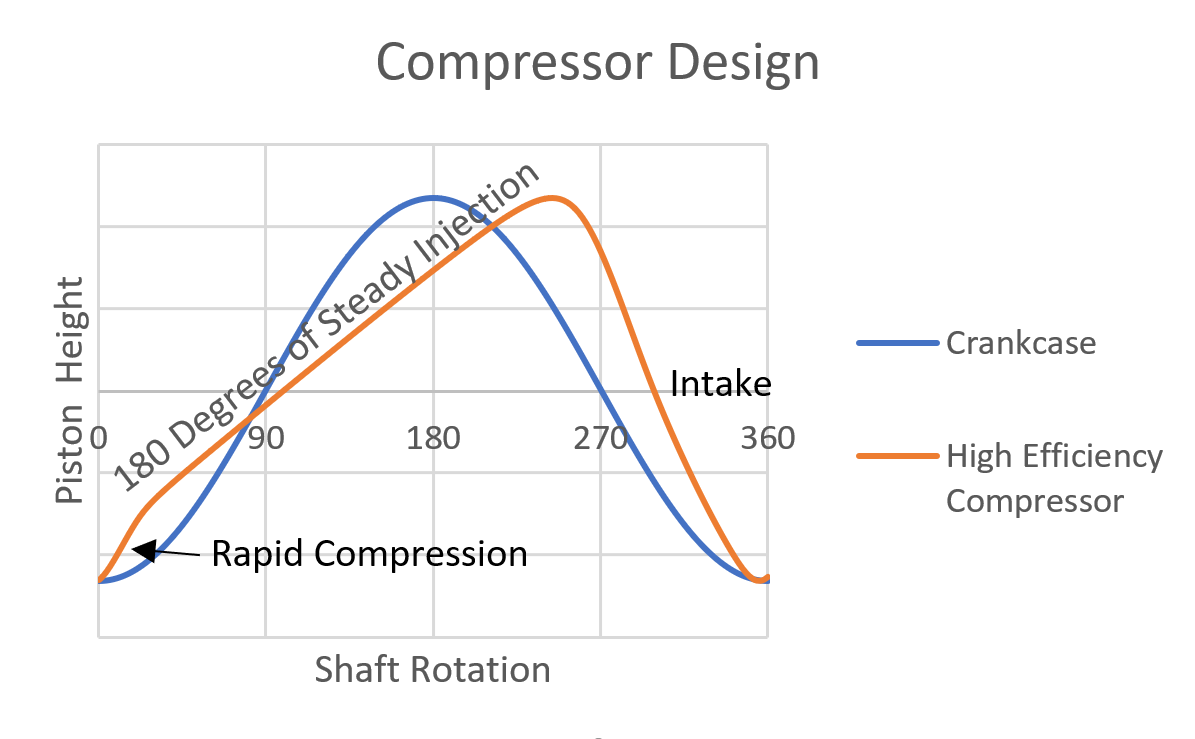
A rolling interface removes that constraint: the piston-height curve is specified directly, and the raceway shapes are computed to roll it. In this study the specified cycle injects smoothly across 180 degrees of shaft rotation. Smooth injection keeps pressure from spiking, and spreading injection across 180 degrees lets two cylinders do work that takes four or more today — with fewer valves, pistons, cams, manifolds, and less cooling infrastructure. The interface itself is a more complex part; the machine around it gets simpler. The design intent is that the trade nets out to lower upfront cost as well as lower running cost.
Summary
What this design study points to — stated as the modeled possibilities they are:
- The cycle defines the geometry, instead of the crank constraining the cycle.
- Meaningfully lower energy use per unit of refrigerant moved — magnitude to be established by prototype and measurement.
- Fewer cylinders and less supporting hardware — a path to lower upfront cost, not just lower running cost.
That last pairing matters most. Efficiency usually costs more up front, and the premium is what slows adoption. A design that is simpler and more efficient would not face that trade — which is why compressors, which consume a substantial share of the world's electricity through HVAC and refrigeration, are among the highest-leverage places this technology could land. A transition to next-generation refrigerants would be a natural moment to introduce it. All of it earns the word “could” until hardware runs — and building that hardware is the point of the current phase.