Case Study: Engine Crankcase Replacement
The crankcase in an internal-combustion engine is a four-bar linkage (the piston and cylinder wall are the fourth bar), and the concept is centuries old. Its geometry imposes a quiet constraint with a large cost: the compression ratio and the expansion ratio come out equal. Compression is capped by the air-fuel mix, so the expansion ratio is capped with it — and roughly half the available energy in the cylinder is still there, unused, when the exhaust valve opens. (You then pay again, for a muffler sized to dissipate it.)
The Atkinson engine attacks exactly this, by adding linkage bars to decouple the strokes. It works, and variants appear where efficiency demands are high — but the linkage is bulky, which costs energy density, and side-loading the piston adds friction and wear. Each fix is a discrete patch on a continuous problem.
A rolling interface takes the continuous problem on its own terms. The piston's height is specified directly, as a curve against shaft angle, and the raceways are computed to roll that motion — so the best cycle defines the geometry, rather than the crank constraining the cycle. The constraint that expansion must equal compression simply disappears from the formulation.
This study's design requirements:
- All four strokes completed in 360 degrees of shaft rotation.
- A power stroke twice as long as the compression stroke.
- Exhaust, intake, and compression within 240 degrees, leaving 120 degrees for power.
- Mechanical advantage varied through the power stroke toward constant torque. (This requires a force-over-distance curve for combustion that is not yet available — noted as an open input, not assumed.)
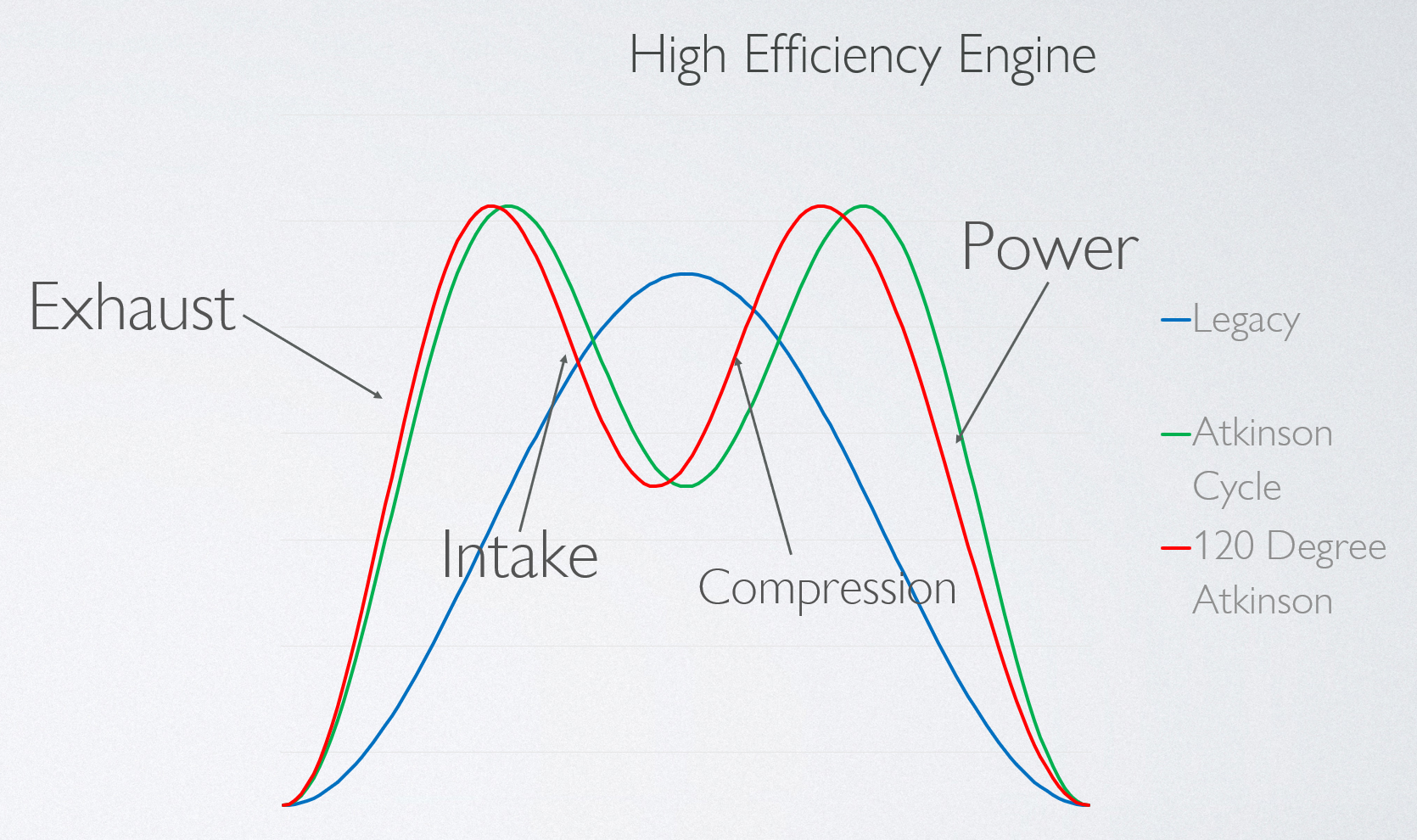
Requirement 2 is the Atkinson idea without the linkage: more of the expansion harvested, with modeled efficiency gains in the tens of percent — a magnitude that hardware, not modeling, will have to confirm. Better fuel use means lower emissions, CO₂ included.
Requirement 3 allows three cylinders instead of four, since one cylinder is always in its power stroke — fewer pistons, valves, cams, manifolds, and less cooling. Requirement 4 aims at smoothness by design: engines today buy smoothness with cylinder count, six, eight, twelve. Shaping the output directly could let a few cylinders run as smoothly as many — conceivable, and unproven until built.
The cycle compresses further. Squeezing exhaust, intake, and compression into 180 degrees leaves 180 degrees for power and reduces the engine to two cylinders. The specified piston height against shaft rotation:
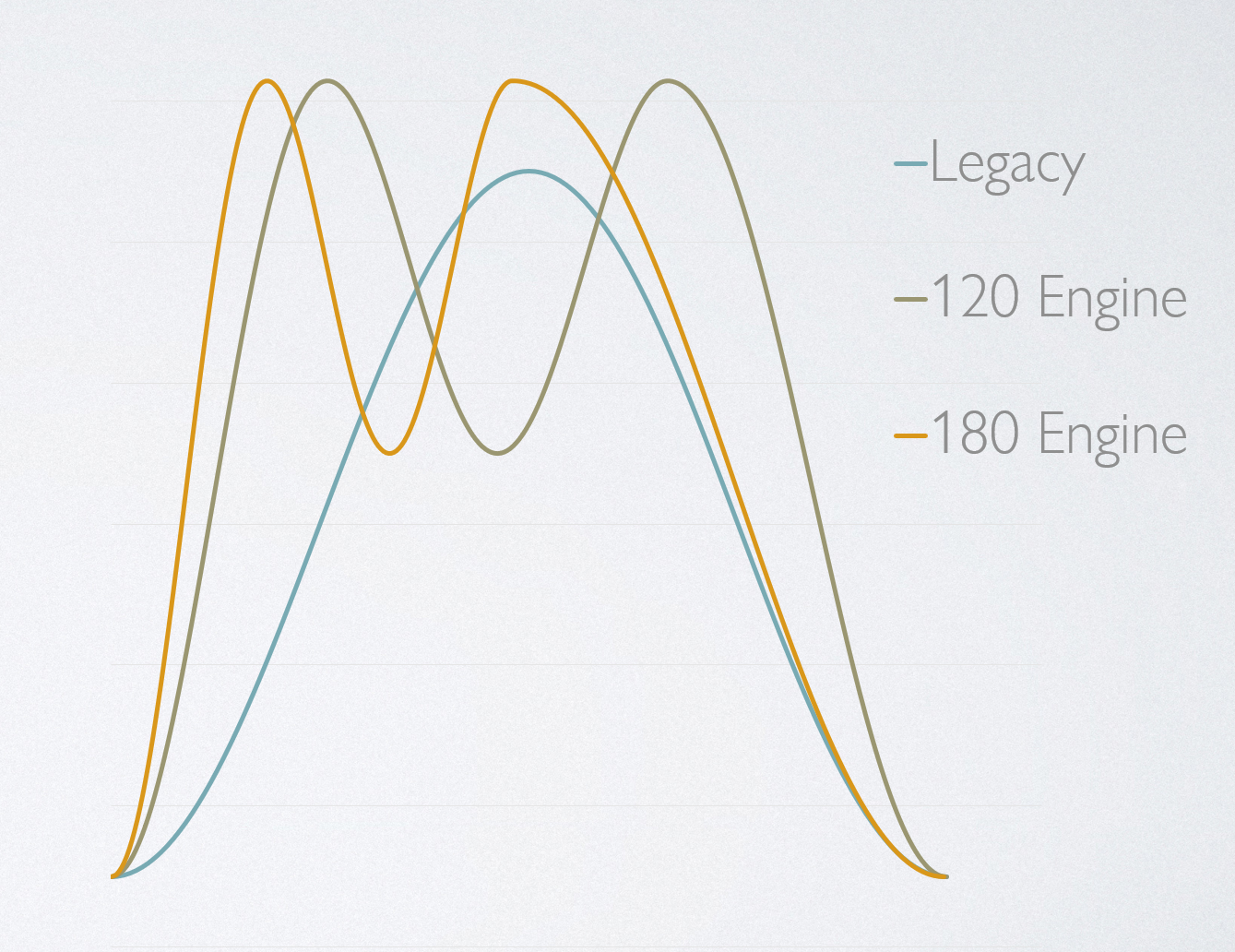
Both configurations are modeled design studies: the motions are solved and animated; no engine has been built. They are shown because they demonstrate the capability that matters — when the mechanism can roll any specified motion, a 150-year-old constraint becomes a design variable. What that is ultimately worth is a question for hardware, and it is the kind of question this technology exists to put to the test.