Efficient Robotic Walking
Walking robots pay an energy tax that wheels don't. To move forward while keeping the body level, one limb is always lifting the robot while another lowers it — energy in, energy out, every stride. Every step is also a push-up. Losses in the leg's transmission make it impractical to recover that energy regeneratively, so designers reach for springs, or put wheels under the feet, to blunt the cost.
The tax scales with the robot's weight. For a robot whose job is carrying material, that makes payload and battery life a direct trade-off.
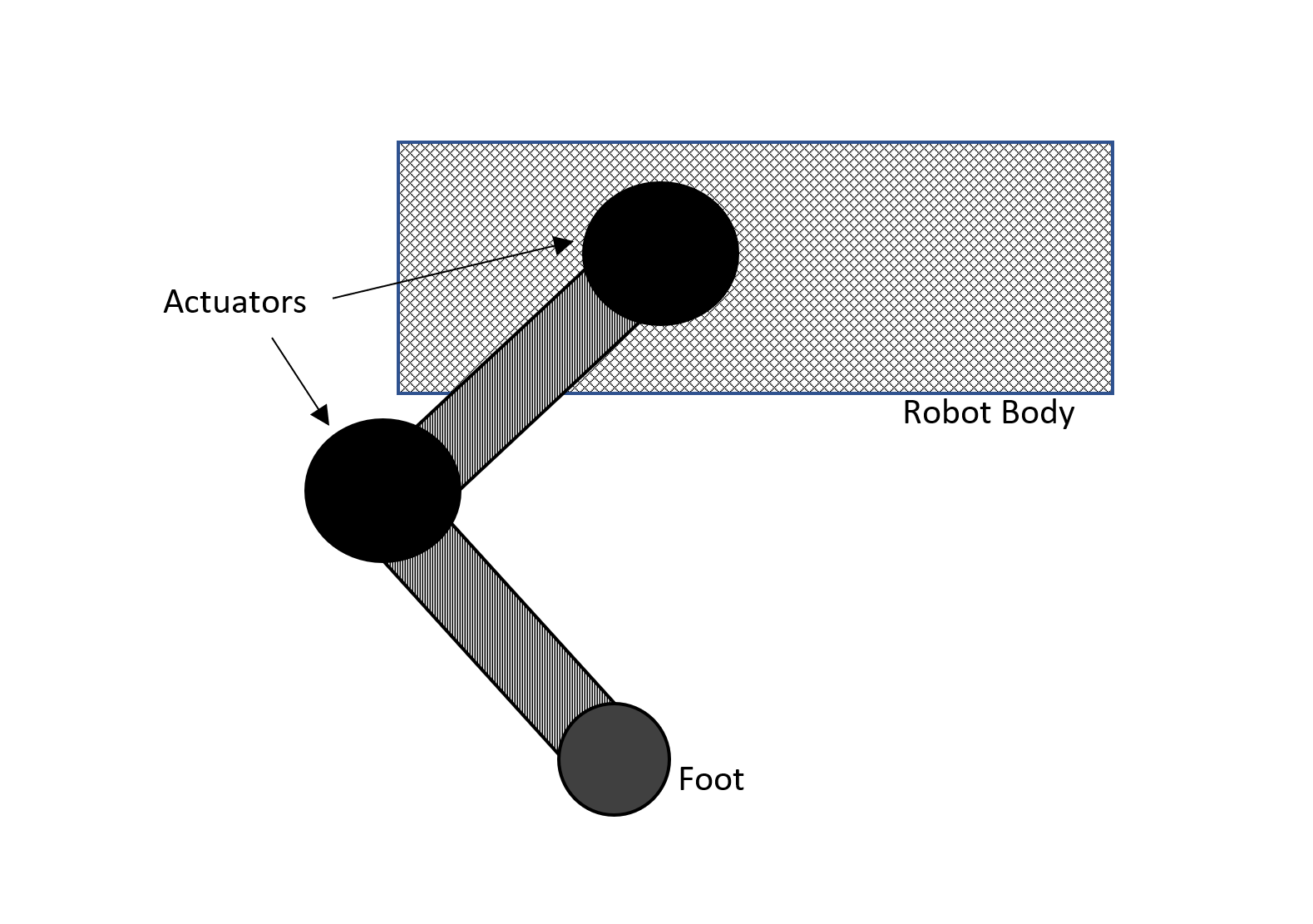
A better way
We designed a leg joint that does not lift the robot's body as the limb swings. Built on rolling interfaces, the joint's motion is specified so the leg itself rises at the end of the stroke while the body stays level. In the animation the body travels with an energy cost similar to rolling — and once moving, it keeps moving on very little input. On some surfaces the modeled cost could even beat a wheel. Like everything on this site, those are design-study figures awaiting hardware.
A second expected benefit is agility. In a conventional limb, the actuators hold load even when the robot stands still, so every movement starts from a loaded state. This joint carries no actuator load at rest — making the first degree of motion cheap.
The approach scales, and it doesn't ask the robot to give anything up. Solve the joint once and the same method solves the next one — the shapes are computed, so a mechanism made for one joint can be made for two. And only the section of the joint's range that the walking stride uses needs the specialized shape: the rest of the raceway stays circular, an ordinary rotary joint, so the leg keeps its full agility for uneven ground, crouching, and recovery. Efficiency where the stride lives; unrestricted motion everywhere else.
The final animation shows one possible walking configuration; many others are available, since the gait is a motion specification, not a fixed mechanism — four legs, or four legs with an added joint, follow from the same method.